Orlando's first airport is now its general aviation field. Here is what happens there, where it sits, and whether it matters if you live in Lake Nona.
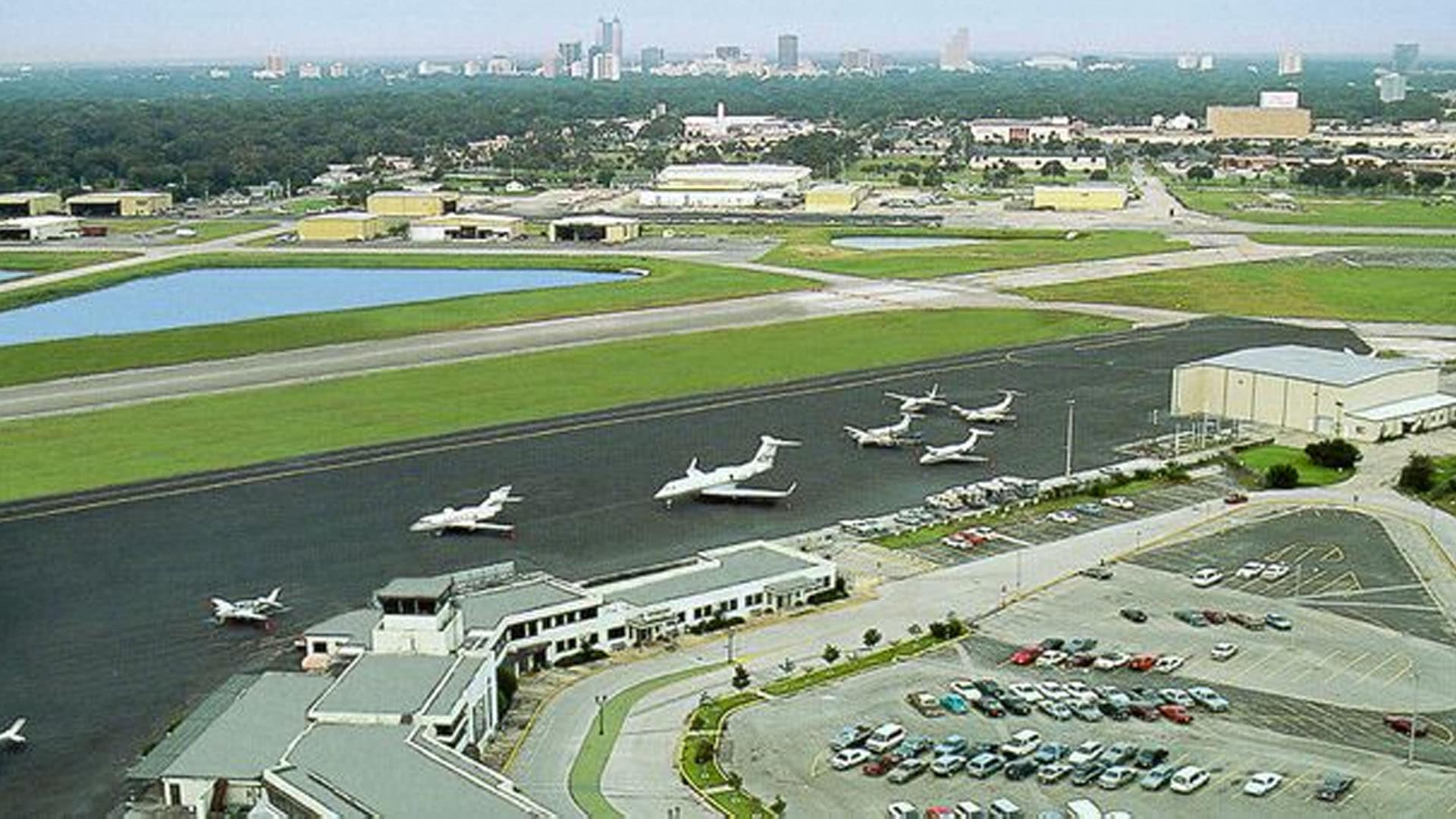
Orlando Executive Airport (ORL, KORL) is a public general aviation airport three miles east of downtown Orlando. It has no scheduled airline service. The Greater Orlando Aviation Authority operates it alongside Orlando International (MCO), and ORL is MCO's designated reliever airport. Its users are business aircraft, private pilots, flight schools, air ambulance and law-enforcement aircraft. It sits about 13 miles in a straight line from Lake Nona Town Center, more than twice the distance to MCO.
Ask a new Lake Nona resident which airport is closest and they will say MCO, and they are right. Ask which airport Orlando started with and most people do not know it is still running, three miles from the downtown skyline, with no airliners and a busier ramp than most people would guess.
Orlando Executive Airport rarely comes up in a Lake Nona home search. It comes up after the move: when a new neighbor turns out to fly their own plane, when a teenager wants a pilot's license, or when a business guest asks where to land a jet. This is the plain answer to what ORL is, where it sits, and who actually uses it.
What is Orlando Executive Airport?
Orlando Executive Airport is a public general aviation airport with two runways, two fixed-base operators and no airline service, operated by the Greater Orlando Aviation Authority (GOAA).
"General aviation" covers everything that is not a scheduled airline: corporate jets, charter flights, privately owned planes, helicopters, flight training, medical transport and police aviation. GOAA, the same authority that runs Orlando International Airport, designates ORL as MCO's reliever. In practice that means smaller aircraft have somewhere to go other than a commercial airport's runways.
The main runway, 7/25, is 6,004 feet long and 150 feet wide. The crosswind runway, 13/31, is 4,625 feet by 100 feet. Two fixed-base operators, Atlantic Aviation and Sheltair, sell fuel, park and hangar aircraft, and handle passengers. A fixed-base operator, or FBO, is the private terminal a jet passenger walks through instead of an airline concourse.
Where is Orlando Executive Airport located?
ORL is three miles east of downtown Orlando, in Orange County, bounded by the major east-west roads State Road 408, State Road 50 and State Road 436.
It is an urban airfield, surrounded by established neighborhoods and commercial corridors rather than open land. That location is the point: a passenger landing at ORL is a short trip from the office towers of downtown Orlando.
From Lake Nona, ORL is about 13 miles in a straight line from Lake Nona Town Center, heading north-northwest. MCO is about 5.5 miles away on the same measure. The road trip to ORL is longer than the straight-line figure, and it runs through the city rather than around it. For more on how Lake Nona sits relative to the rest of the metro, see Where Is Lake Nona.
| Codes | ORL (FAA and IATA), KORL (ICAO) |
|---|---|
| Operator | Greater Orlando Aviation Authority |
| Location | Three miles east of downtown Orlando, Orange County |
| Distance from Lake Nona Town Center | About 13 miles straight-line (MCO: about 5.5 miles) |
| Size | About 970 acres (GOAA 2026 fact sheet: 969) |
| Runways | 7/25: 6,004 x 150 ft; 13/31: 4,625 x 100 ft |
| FBOs | Atlantic Aviation, Sheltair |
| Control tower | 7 a.m. to 10 p.m.; airport open 24 hours |
| U.S. Customs | On site since 2007; weekdays 8:30 a.m. to 5 p.m., user fee |
| Airline service | None since 1966 |
Who does Orlando Executive Airport serve?
ORL serves business and charter flights, private aircraft owners, student pilots, and public-service aircraft such as air ambulances, law enforcement and search and rescue.
GOAA's 2026 fact sheet counts 292 aircraft based on the field: 164 single-engine planes, 41 multi-engine planes, 59 jets and 27 helicopters. About 65 percent of operations are itinerant, meaning aircraft arriving from or leaving for somewhere else, and about 35 percent are local, which is mostly training traffic in the pattern.
Four groups account for most of that traffic:
- Business travelers. Corporate and charter jets use ORL because it puts passengers close to downtown without sharing airspace sequencing and ramp space with airliners.
- Private owners. Pilots who own their aircraft base them in hangars and tie-downs on the field.
- Flight training. Several flight schools operate from ORL, which is why the local share of traffic is so high.
- Public service. GOAA lists law enforcement, air ambulance and search and rescue among the airport's roles.
International private flights can clear customs here. U.S. Customs and Border Protection opened its ORL facility in 2007 and inspects arrivals Monday to Friday, 8:30 a.m. to 5 p.m., excluding federal holidays. A user fee applies and pilots must request permission to land in advance.
Can you fly commercially out of Orlando Executive Airport?
No. ORL has had no scheduled airline service since 1966, and every commercial flight from the Orlando area uses Orlando International.
Airlines left ORL for a physical reason. The first jet airliners needed more runway than its 6,000-foot strip could offer, so Delta, Eastern and National moved to a jetport on the former McCoy Air Force Base. That jetport grew into MCO, which now borders Lake Nona. If a charter operator quotes you a private flight "from Orlando," ask which airport; it may be either one.
Is ORL or MCO the better airport for private flying from Lake Nona?
For most Lake Nona residents MCO is the practical choice, because it is less than half the distance and its private terminals operate around the clock; ORL makes more sense for training, for small aircraft, and for trips that end downtown.
Private aviation at MCO runs through its own FBOs, including Signature Flight Support and Atlantic Aviation, both open 24 hours with customs on site. A resident chartering a jet to a family event in the Northeast will usually find MCO the shorter trip from home.
ORL wins on different terms. It is built for general aviation, so a student in a single-engine trainer is not sharing a runway with airliners. Its customs hours are weekday business hours, though, and its tower closes at 10 p.m. For simulator-based pilot training, see our post on SimCom's aviation training center.
How did Orlando Executive Airport get its name?
It opened in 1928 as Orlando Municipal Airport, became Herndon Airport in 1961, and took the name Orlando Executive Airport in 1982.
Some online guides put the rename in 2007. GOAA's own timeline says 1982; 2007 is the year the customs facility opened. The sequence, from GOAA's 2026 fact sheet:
- 1928: Opens as Orlando Municipal Airport, Central Florida's first commercial airfield.
- 1940: The Army Air Corps takes over and renames it Orlando Army Air Base.
- 1946: Returned to the City of Orlando; National, Eastern and Delta fly passengers.
- 1951: A passenger terminal opens.
- 1961: Renamed Herndon Airport after city engineer Pat Herndon.
- 1966: The airlines move to the jetport at McCoy, today's MCO.
- 1976: The city hands operational control to GOAA.
- 1982: Renamed Orlando Executive Airport.
- 1995: A new FAA control tower opens.
- 2007: The U.S. Customs and Border Protection facility opens.
How busy is Orlando Executive Airport?
ORL handled roughly 180,000 to 190,000 aircraft operations in 2025, up from about 100,000 in 2017.
The exact 2025 figure depends on which GOAA document you read. The 2026 fact sheet's traffic table lists 181,493 operations, while GOAA's ORL web page says more than 190,000. Either way the trend is plain: traffic rose sharply after 2020 and has held above 180,000 since 2023. GOAA puts the airport's regional economic impact at $577 million (2022 figure), with more than 4,000 jobs.
The field is also being maintained rather than wound down. GOAA reports a Runway 7/25 resurfacing completed in 2026, a new airport beacon in 2026, a taxiway project planned for 2027 and a Runway 13/31 rehabilitation scheduled for 2029.
Pros and cons of Orlando Executive Airport for Lake Nona residents
Pros
- Dedicated to general aviation, with no airline traffic on its runways.
- On-site U.S. Customs for international private arrivals.
- Close to downtown Orlando for business trips that end there.
- Two competing FBOs and several flight schools on one field.
Cons
- About 13 miles straight-line from Lake Nona, versus about 5.5 to MCO.
- Customs is weekdays only, business hours only, and charges a fee.
- The control tower closes at 10 p.m.
- No airline service, so it does nothing for most household travel.
Our Take: Most Lake Nona households will never use ORL, and that is fine. MCO is closer, handles every airline flight and has 24-hour private terminals. ORL earns a place on your map if you are learning to fly, own a small aircraft, or regularly fly guests into downtown Orlando. For everyone else it is useful background: when someone says "Orlando Executive," you will know it is not the airport your flight leaves from.
What the Neighbors Know
Lake Nona grew up in MCO's orbit, not ORL's. MCO borders the community, and it is the airport most residents mean when they say "the airport." ORL is the city's older field, still busy, still useful, and on the far side of town.
If you are weighing Lake Nona and aviation matters to you, the useful question is not which airport is nearer but which one you will use. Airline travelers and most charter passengers will be well served by MCO. Pilots should look at both fields before deciding where to base an aircraft. For more on getting around from here, see Explore Orlando and the our Lake Nona Town Center guide.
Official sources
- GOAA: Orlando Executive Airport general information
- GOAA: Orlando Executive Airport fact sheet, 2026 (PDF)
- U.S. Customs and Border Protection: KORL general aviation fact sheet (PDF)
- GOAA: Noise abatement program
Thinking about a move to Lake Nona, with or without a hangar in the plan? Call/Text David Myers at 407.801.3286 or use the contact form.
Frequently asked questions about Orlando Executive Airport
Is Orlando Executive Airport the same as Orlando International Airport?
No. Orlando Executive (ORL) is a general aviation airport three miles east of downtown Orlando. Orlando International (MCO) is the commercial airline airport south of the city, next to Lake Nona. Both are run by the Greater Orlando Aviation Authority, and ORL is the designated reliever airport for MCO.
Can you catch an airline flight at Orlando Executive Airport?
No. ORL has had no scheduled airline service since 1966, when Delta, Eastern and National moved to the jetport that became Orlando International. Travelers flying commercially from Lake Nona use MCO.
How far is Orlando Executive Airport from Lake Nona?
About 13 miles in a straight line from Lake Nona Town Center, to the north-northwest. Orlando International is about 5.5 miles away on the same measure, so MCO is the closer airport for Lake Nona residents.
Can international private flights clear customs at ORL?
Yes. U.S. Customs and Border Protection has operated a facility at ORL since 2007. Arrival inspections run Monday to Friday, 8:30 a.m. to 5 p.m., excluding federal holidays; a user fee applies and pilots must follow the permission-to-land procedure.
Is Orlando Executive Airport open 24 hours?
The airport is open around the clock, but the FAA control tower operates from 7 a.m. to 10 p.m. Outside tower hours, pilots operate under the airport's non-towered procedures.
Who owns Orlando Executive Airport?
The Greater Orlando Aviation Authority operates it. GOAA describes the airport land as owned by the City of Orlando, which handed operational control to GOAA in 1976.