The airport next door got a new wing, a record year and a rail partner in bankruptcy talks. Here is what that means if you live in Lake Nona.
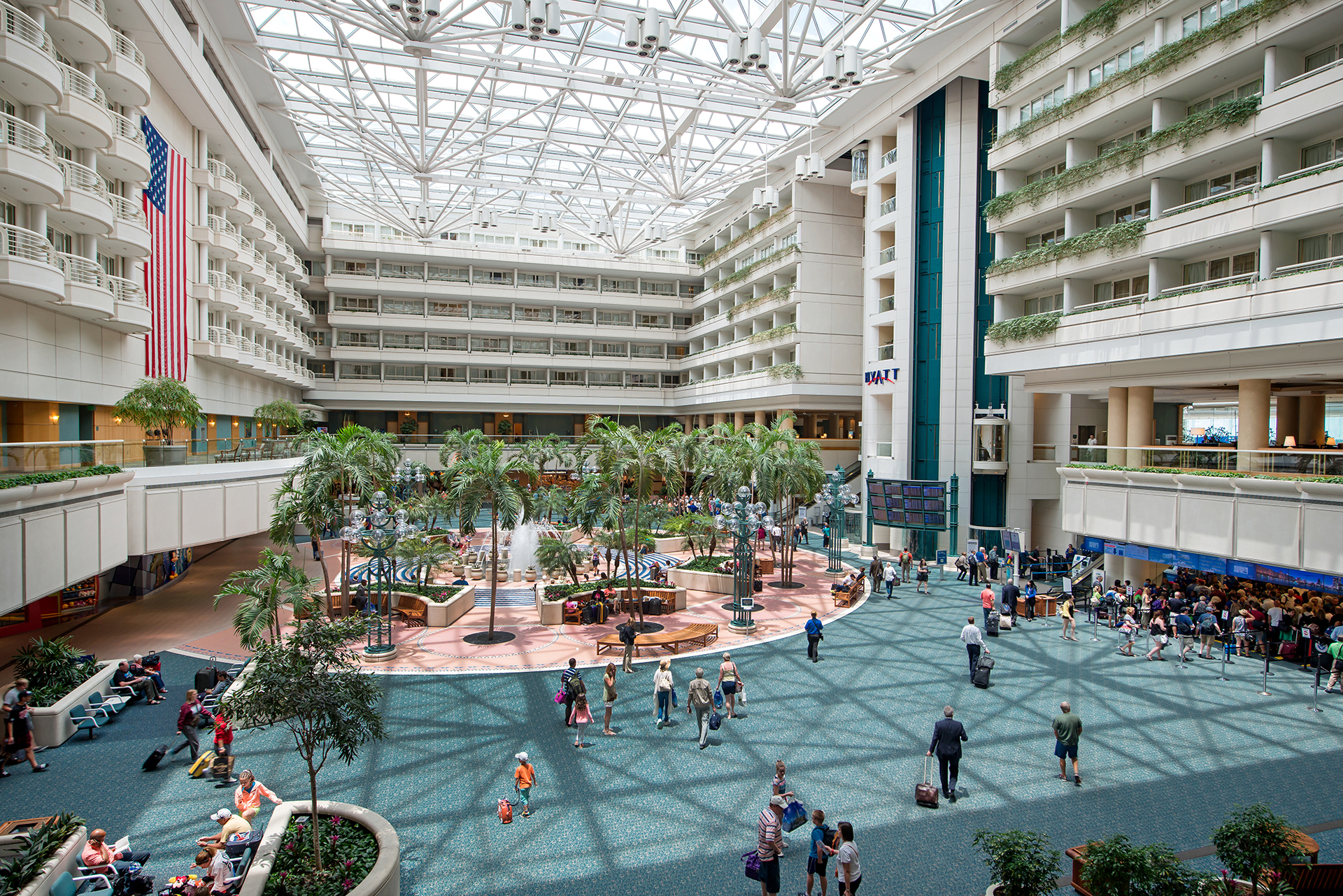
Orlando International Airport (MCO) borders Lake Nona to the northwest and is reached from Lake Nona through its south entrance off SR-417 and Boggy Creek Road. MCO handled 57,675,573 passengers in 2025, the seventh-highest total in the United States and the highest in Florida. A new Terminal C wing with gates 250 through 254 opened on June 30, 2026. Brightline trains to Miami leave from the station beside Terminal C; SunRail does not yet serve the airport. The Lake Nona vertiport announced in 2020 has not been built, and its aircraft partner, Lilium, is insolvent.
Most suburbs sell themselves as "close to the airport" and mean the same side of the county. Lake Nona means the fence line. The airport's southern property runs right up to the Medical City end of the community, and the south entrance feeds straight out onto the roads Lake Nona residents already drive every day.
This post was first published in April 2025. It has been rewritten for September 2026 because enough changed to make the old version wrong in places — a new terminal wing, a new traffic ranking, a rail partner in financial trouble, and a vertiport that is not going to happen the way it was pitched.
How far is Orlando International Airport from Lake Nona?
MCO is Lake Nona's next-door neighbor: its south side borders the community, and Marriott lists its Courtyard on Lake Nona Boulevard at about 7.9 miles from the airport.
That figure is from the hotel district beside Medical City, which is about as close as Lake Nona gets. Homes out along Narcoossee Road and the eastern neighborhoods add miles, so price the trip from the actual address rather than from a brochure. For the bigger picture on where the community sits in the metro, see where Lake Nona is.
The detail that matters more than the mileage is the direction you come in from. Jeff Fuqua Boulevard runs south through airport property to SR-417 at Boggy Creek Road. That south access road is the Lake Nona side of the airport, and it keeps you off the Beachline Expressway, which is where most of the tourist traffic headed for the north side and International Drive piles up. The airport's own signage calls it the South Exit. Learn it once and you will stop giving visiting relatives the rental-car directions to I-Drive.
We deliberately do not quote a drive time here. It swings too much with the hour, the terminal and the rain. Our commuting post covers getting from Lake Nona to MCO and the region's job centers in more depth.
| Operator | Greater Orlando Aviation Authority (GOAA) |
|---|---|
| 2025 passengers | 57,675,573 — 7th in the U.S., 25th in the world, 1st in Florida |
| Terminals | A and B (north complex), C (south, opened 2022) |
| Newest gates | 250–254, Terminal C, opened June 30, 2026 |
| Nonstop destinations | More than 170, per GOAA |
| Rail | Brightline to South Florida from the Intermodal Terminal; no SunRail service yet |
| Lake Nona access | South entrance via Jeff Fuqua Boulevard from SR-417 / Boggy Creek Road |
Which MCO terminal will I fly from?
It depends on the airline: MCO runs Terminals A and B in the original north complex and Terminal C on the south side, and most international carriers now use C.
Terminal C opened in September 2022. On June 30, 2026 the airport opened a new wing there with gates 250 through 254, part of a $462 million expansion that had been planned with the original terminal and deferred during the pandemic. GOAA says the added gates lift Terminal C's capacity to 10 to 12 million passengers a year. Virgin Atlantic moved from Terminal A to Terminal C the same day, joining most of the other international airlines.
The new gates use the MARS layout already in Terminal C: each can take several narrow-body jets or fewer wide-bodies, and any airline on the common-use system can board from them. The practical effect for travelers is less crowding in A and B, which are next in line for renovation — new restrooms across all four airsides and refreshed interiors at Airsides 1 and 3.
If you connect between the two sides, the Terminal Link people mover runs between Terminal C and Terminals A and B. Allow for it. The airport's own advice is to confirm your terminal before you leave home, and that advice is worth following in a year when airlines are still being shuffled around.
How busy is Orlando International Airport in 2026?
MCO served 57,675,573 passengers in 2025, up 0.8% on 2024, which moved it from ninth to seventh busiest in the United States while national traffic fell.
That ranking comes from Airports Council International North America's 2025 figures, released in July 2026. MCO also remained the busiest airport in Florida, just ahead of Miami International. Growth came from overseas: international passengers rose roughly 8% while domestic traffic slipped slightly.
New long-haul service drove much of that. In 2025 MCO added routes to Paris, Munich, Madrid, Lima and Hamilton, Ontario, and in February 2026 it hosted the first passenger flights between Florida and Asia, a short run of ZIPAIR charters to Tokyo Narita. TAP Air Portugal announced Orlando–Lisbon service for October 2026, subject to government approval — check before you plan around it.
Southwest is the largest carrier at MCO, and Frontier and Breeze also run operating bases here, with JetBlue treating Orlando as a focus city. For Lake Nona that mix means plenty of low-fare domestic options without a connection, which is the part of "airport access" most households actually use.
Can I take a train from the airport to Miami or downtown Orlando?
You can reach Miami by Brightline from the station beside Terminal C, but you cannot reach downtown Orlando by rail from MCO yet.
Brightline began carrying passengers between MCO and South Florida on September 22, 2023, from the Intermodal Terminal next to Terminal C. It stops at West Palm Beach, Fort Lauderdale and Miami along the way. We cover the Lake Nona angle in our post on Brightline and South Florida.
The company's finances are the story to watch this fall. On September 22, 2026, Bloomberg reported that Brightline was preparing a Chapter 11 filing to restructure its corporate debt. According to those reports, the filing would leave out the operating company, and trains between Miami and Orlando are expected to keep running on schedule. The planned extension from Orlando to Tampa is a different matter; its timing is now unclear. Treat Brightline as a working train with an uncertain expansion plan.
SunRail, the region's commuter line, does not reach the airport. Riders get off at Sand Lake Road station and take a free Lynx bus to MCO. The Sunshine Corridor project would run SunRail into the airport and on to the Convention Center and International Drive, but it is still in a two-year study approved in April 2025, with a cost estimate above $4 billion and no construction date.
What happened to the Lake Nona vertiport?
Nothing has been built, and the aircraft company behind it, Lilium, stopped operating in December 2024 and went through insolvency.
In November 2020, Tavistock, the City of Orlando and Lilium announced a $25 million vertiport for electric air taxis in Lake Nona's airport-side commercial district, south of Medical City and east of Boggy Creek Road. The target was 2025. The earlier version of this post described a future connection between MCO and that vertiport as part of the plan.
Lilium laid off about 1,000 workers when it ceased operations in December 2024, and a rescue deal fell through in early 2025. We have found no public announcement of construction or a replacement aircraft partner since. Until Tavistock names one, count the vertiport as shelved, and be skeptical of any listing that still uses it as a selling point.
Does airport noise affect Lake Nona neighborhoods?
Some Lake Nona streets do hear aircraft, because MCO sits directly northwest of the community and the airport's noise program favors south-flow operations.
MCO's published noise-abatement program lists preferential runway use favoring south flow, assigned headings for northbound departures, and a night rule: between 11 p.m. and 7 a.m., during north-flow operations, departing aircraft are turned east on climb-out, away from long-established communities. The Federal Aviation Administration, not the airport, controls the flight paths, and weather or runway work can override any of it.
What that means in practice is uneven. The wind decides which way planes take off, and a street a mile from another can have a very different experience. Before you sign a contract, look up the address on the airport's flight-tracking tool and sit outside at the property at more than one time of day. The noise office also takes questions on 407-825-2674.
How did an Air Force base become Orlando's airport?
MCO began as a wartime airfield, became McCoy Air Force Base, shared its runways with airlines from 1961, and took the name Orlando International Airport in 1976.
The field was built in 1940 and became Pinecastle Army Airfield in 1943. During the Cold War it was a Strategic Air Command base for B-47 bombers. On October 9, 1957, the base commander, Colonel Michael N. W. McCoy, was killed when his B-47 broke up during a practice demonstration northwest of downtown Orlando. The base was renamed McCoy Air Force Base on May 7, 1958. (The earlier version of this post dated the crash to 1958. It was 1957.)
Airline service moved over from Herndon Airport, now Orlando Executive, in October 1961, because the new jets needed longer runways. The Air Force left in 1975, the Orlando Jetport at McCoy became Orlando International Airport in 1976, and the main terminal opened in 1981. The code MCO is the last trace of McCoy. For the ranch-land story of Lake Nona itself over the same years, see Lake Nona history.
Pros and cons of living next to MCO
Pros
- A south entrance that keeps airport trips off the Beachline and away from the I-Drive traffic.
- More than 170 nonstop destinations, including a growing list of European cities, from the airport closest to your house.
- Brightline to South Florida from the same complex, without driving Florida's Turnpike.
- An airport next to Medical City and the aviation employers on this side of town, such as SimCom's training center.
Cons
- Aircraft noise on some streets, depending on the wind and the runway in use.
- No rail link to downtown Orlando, and no date for one.
- Brightline's restructuring leaves its expansion plans uncertain.
- The vertiport that marketing materials promised has not materialized.
Our take: The airport is a real, everyday advantage for Lake Nona, but the reasons are plainer than the old marketing suggested. It is the south entrance, the nonstop list and a terminal wing that should thin out the crowds. It is not flying taxis, and it is not a train to downtown. If you travel often, weight it heavily. If you are noise-sensitive, weight the specific street more heavily than the neighborhood name.
What the neighbors know
People who have lived in Lake Nona a while tend to use the airport the way other people use a grocery store: pick someone up at Terminal C, drive home the back way, done. The regulars know which gate area the international flights come into and which exit keeps them off the Beachline. The ones who moved here for a job at Medical City often did so partly because they could fly in for the interview on a nonstop.
What they also know is that "close to the airport" cuts both ways. The same proximity that makes a 6 a.m. flight painless puts a flight path over some roofs. That is why we look at a street's position relative to the runways before we look at the kitchen. See the rest of our Lake Nona roads and transportation guide, and browse Lake Nona neighborhoods with the map open.
Official sources
- Orlando International Airport (flymco.com)
- MCO press releases
- MCO noise abatement and flight tracking
- Brightline
- SunRail
Buying or selling near the airport? Call/Text David Myers at 407.801.3286 or use the contact form. We will tell you which streets sit under which flight paths before you fall for the house.
Frequently asked questions
How far is Orlando International Airport from Lake Nona?
MCO borders Lake Nona to the northwest. Marriott lists its Courtyard on Lake Nona Boulevard, beside Medical City, at about 7.9 miles from the airport. Homes farther east along Narcoossee Road sit farther out, so check the mileage from the specific address.
Which MCO entrance is closest to Lake Nona?
The south entrance. Jeff Fuqua Boulevard runs south through the airport to SR-417 at Boggy Creek Road, which puts Lake Nona drivers onto airport property without using the Beachline Expressway on the north side.
Which airlines use Terminal C at MCO?
Terminal C, which opened in 2022, hosts most of the international airlines serving Orlando. Virgin Atlantic moved there from Terminal A on June 30, 2026, when the new gates 250 through 254 opened. Airlines change terminals, so confirm yours before you leave the house.
Can I take a train from Orlando International Airport?
Yes, to South Florida. Brightline runs from the Intermodal Terminal next to Terminal C to West Palm Beach, Fort Lauderdale and Miami. SunRail does not reach the airport; its riders transfer at Sand Lake Road station to a Lynx bus. The Sunshine Corridor plan to bring SunRail to MCO is still in study with no construction date.
Is the Lake Nona vertiport still being built?
No construction has been announced. The vertiport was announced in November 2020 with Lilium as the aircraft partner, and Lilium ceased operations in December 2024 and entered insolvency. Treat it as shelved unless Tavistock announces a new partner.
Do planes fly over Lake Nona?
Some do. MCO sits directly northwest of Lake Nona, and the airport’s noise program favors south-flow operations. How much you hear depends on the street and the wind that day. The airport runs a public flight-tracking and noise-complaint tool, and it is worth checking for a specific address before you buy.

:format(webp):quality(80)/u.realgeeks.media/lakenonafloridaproperties/Lake_Nona_Buyers_Guide_Square.jpg)
:format(webp):quality(80)/u.realgeeks.media/lakenonafloridaproperties/lake-nona-map-search.jpg)
:format(webp):quality(80)/u.realgeeks.media/lakenonafloridaproperties/lakenonafloridaproperties-realtor-david-myers-sidebar.jpg)