Sandy loop trails, gopher tortoises and a 200-year-old split oak, plus where the planned toll road stands in September 2026
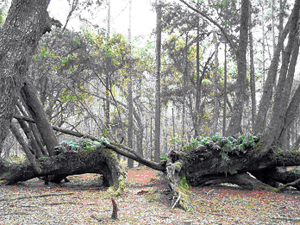
Split Oak Forest Wildlife and Environmental Area is a 1,689-acre preserve on the Orange-Osceola county line, just south of Lake Nona. It is jointly owned by Orange and Osceola counties and managed by the Florida Fish and Wildlife Conservation Commission (FWC) as a gopher tortoise mitigation area. Hiking is free with no permit, dogs are allowed under physical restraint, and bicycles are not permitted. The main trailhead is at 10525 Clapp Simms Duda Rd, and hikers can also enter from Orange County's Moss Park. The planned Osceola Parkway Extension (State Road 534) is routed through the preserve's southern portion, and reporting in September 2026 said construction could begin in 2027.
South of Lake Nona, the pavement gives way to sugar sand, saw palmetto and gopher tortoise burrows. Split Oak Forest is one of the best free hikes on this side of Orlando, and it is also at the center of the region's longest-running land-use fight.
This guide covers both: how to hike it now, and where the toll road planned through its southern edge stands as of September 2026. An earlier version of this post said dogs weren't allowed and that construction was years away; both have been corrected.
What is Split Oak Forest?
Split Oak Forest is a 1,689-acre protected preserve on the Orange-Osceola county line, owned by both counties and managed by FWC.
The land holds pine flatwoods, oak hammock, scrub, prairie and marsh, kept healthy with prescribed fire. It is not a manicured park: trails are sandy, shade is limited and facilities are minimal.
Why was Split Oak Forest protected?
Split Oak was set aside as a gopher tortoise mitigation park, land preserved to offset tortoise habitat lost to development elsewhere.
A Florida Communities Trust grant for the purchase was approved in 1992, and the preserve was established in 1994. The name comes from a live oak more than 200 years old that split down the middle and kept growing.
Gopher tortoises are a keystone species: their burrows shelter hundreds of other animals. The preserve is also a site on the Great Florida Birding and Wildlife Trail.
What are the trails like at Split Oak Forest?
The trails are flat but sandy: the perimeter loop runs about 6.4 miles, and the named trails total about 7.7 miles.
Long stretches are deep white sugar sand with little shade, so the effort comes from footing and sun rather than hills. Wear real shoes, carry water and a map, and go between October and April if you can. Expect aircraft overhead from Orlando International Airport.
How do you get to Split Oak Forest, and what are the rules?
The main trailhead is at 10525 Clapp Simms Duda Rd, Orlando, FL 32832; hiking is free, dogs are allowed under restraint, and bikes are not.
| Main trailhead | 10525 Clapp Simms Duda Rd, Orlando, FL 32832 (sand parking lot) |
|---|---|
| Second access | Through Orange County's Moss Park, which has restrooms and charges its own entry fee |
| Cost | Free; no daily-use permit required |
| Hours | FWC: 30 minutes before sunrise to 30 minutes after sunset. Orange County lists 8 a.m.–8 p.m. in summer and 8 a.m.–6 p.m. in winter |
| Restrooms and water | None at the trailhead |
| Dogs | Allowed, kept under physical restraint at all times |
| Bikes | Not permitted |
| Horses | Allowed |
Hikers who want restrooms can start from Moss Park, which connects to the preserve's trails. Online guides disagree about dogs; FWC, which manages the preserve, allows them under physical restraint.
What is happening with the toll road through Split Oak Forest?
The Osceola Parkway Extension (State Road 534) is planned through Split Oak's southern portion, the state agencies holding its easements have approved releases, and construction could begin as early as 2027.
| 2020 | Orange County voters approve a charter amendment limiting Split Oak to conservation use |
|---|---|
| May 2024 | FWC approves releasing conservation easements on 60 acres in exchange for about 1,550 acres of adjoining land and management funding |
| Aug. 2025 | The Central Florida Expressway Authority (CFX) declares about 24 acres of Orange County conservation land necessary for the road |
| Jan. 2026 | Orange County commissioners vote 4–3 to reject CFX's purchase offer and fight the eminent-domain case |
| June 2026 | The South Florida Water Management District releases easements on about 55.5 acres |
| Sept. 2026 | CFX holds public design meetings; reporting says construction could begin in 2027 |
SR 534 is a planned toll road running east from SR 417 near Boggy Creek Road into Osceola County, and it is in the design phase. In exchange for the easements, CFX has offered land for preservation, reported at about 1,800 acres. Estimates of the habitat directly or indirectly affected range from about 120 to 160 acres.
Supporters, including many commuters in the Lake Nona area, see the road as overdue traffic relief. Opponents, including Save Split Oak, argue it breaks a promise to protect the land permanently and are pushing for alternatives such as a flyover. CFX's eminent-domain case against Orange County is pending, and the county has also challenged the project. Most of the preserve remains open and intact today.
Pros, Cons and Our Take
Pros
- Free, with no permit, and close to southeast Orlando.
- Real native habitat: gopher tortoises, open prairie and a 200-year-old oak.
- Dogs are allowed under physical restraint.
- Connects to Moss Park for restrooms and a second entry point.
Cons
- No restrooms or water at the main trailhead.
- Deep sand and little shade make summer hikes hard.
- No bicycles.
- A toll road is planned through the southern portion, with construction possible from 2027.
Our Take
Split Oak is worth a cool-season morning for anyone who lives in southeast Orlando. Go soon: the southern trails may look different once road construction starts.
What the Neighbors Know
Residents of Isle of Pines, Eagle Creek, Cove at Nona Sound, Estates at Nona Sound, Isles of Lake Nona and Fell's Landing have the preserve closest. For buyers who value protected land nearby, it is worth knowing where the SR 534 corridor runs relative to a specific home before you commit.
For more green space, see Isle of Pine Preserve and our Lake Nona parks and recreation guide.
Official Sources
- FWC: Split Oak Forest WEA
- FWC: Planning your visit
- FWC: Split Oak easement decision (May 2024)
- Friends of Split Oak Forest
- WMFE: Easement release approved (June 2026)
- WMFE: Orange County rejects CFX offer (Jan. 2026)
- News 13: CFX meetings on the toll road (Sept. 2026)
- CFX: State Road 534 project
Thinking about a home near Lake Nona's preserves? Browse the latest Lake Nona listings, or Call/Text David Myers at 407.801.3286 or use the contact form.
Frequently Asked Questions
Where is Split Oak Forest?
Split Oak Forest is on the Orange-Osceola county line just south of Lake Nona. The main trailhead is at 10525 Clapp Simms Duda Rd, Orlando, FL 32832, and hikers can also enter through Moss Park.
Is Split Oak Forest free?
Yes. Hiking is free and no permit is required. There are no restrooms or water at the main trailhead.
Are dogs allowed at Split Oak Forest?
Yes. FWC allows dogs as long as they are kept under physical restraint at all times.
How long are the trails at Split Oak Forest?
The perimeter loop is about 6.4 miles, and the named trails total about 7.7 miles. The terrain is flat but sandy with little shade.
Is a road being built through Split Oak Forest?
A toll road, the Osceola Parkway Extension (State Road 534), is planned through the preserve's southern portion. FWC and the South Florida Water Management District have approved releasing easements, Orange County is contesting the project, and reporting in September 2026 said construction could begin in 2027.

:format(webp):quality(80)/u.realgeeks.media/lakenonafloridaproperties/Lake_Nona_Buyers_Guide_Square.jpg)
:format(webp):quality(80)/u.realgeeks.media/lakenonafloridaproperties/lake-nona-map-search.jpg)
:format(webp):quality(80)/u.realgeeks.media/lakenonafloridaproperties/lakenonafloridaproperties-realtor-david-myers-sidebar.jpg)