Orange County's biggest park sits on Lake Nona's southern doorstep. Here's the honest local guide, trails included.
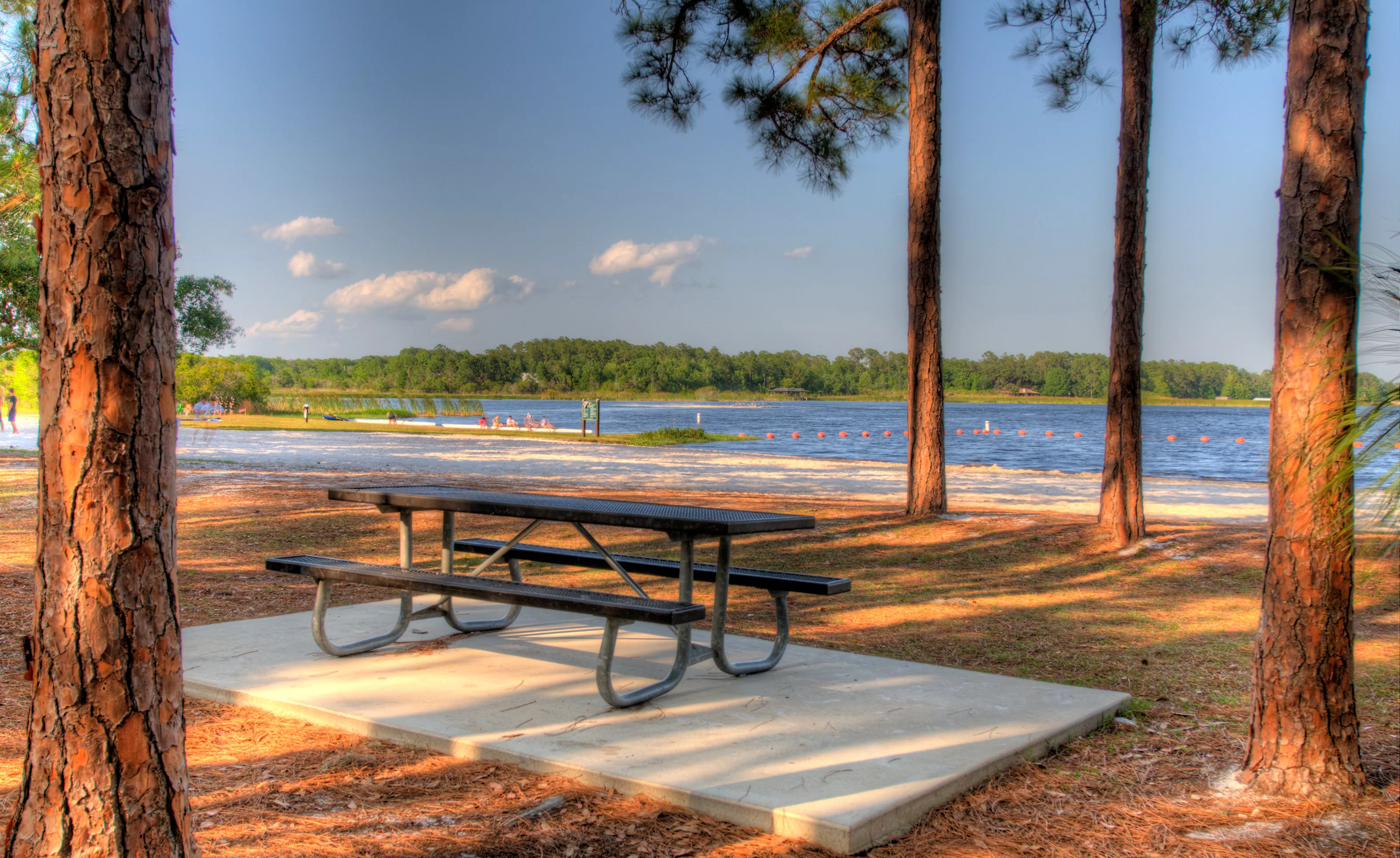
Moss Park is a 1,551-acre Orange County park at 12901 Moss Park Road, Orlando, FL 32832, on the land between Lake Hart and Lake Mary Jane. It is the largest park in the Orange County system. Admission is $3 per vehicle for one or two people and $5 for three to eight, and hours are 8 a.m. to 8 p.m. in summer and 8 a.m. to 6 p.m. in winter. The park has 54 RV and tent campsites, two boat ramps, playgrounds and picnic pavilions. Its two named hiking trails are the Bear Island Nature Trail, now largely part of the Florida Trail, and the Swamp Trail, which crosses the marsh into Split Oak Forest. Pets other than ADA service animals are not allowed.
You know Lake Nona for Medical City, the tennis campus and a Town Center full of restaurants. Fewer people know that its southern edge runs out onto Orange County's largest park: live oaks, two big lakes, a campground, and enough sandhill cranes to make your morning coffee feel like a nature documentary.
It's the kind of place locals drive past for years, then kick themselves once they finally go. This guide covers the whole park, with the most space given to the part most guides skim, which is the trails. The good parts, the alligator-shaped caveats, and one naming mix-up that trips up home buyers are all in here.
What is Moss Park, and where is it?
Moss Park is a county-owned regional park at the end of Moss Park Road in southeast Orlando, on a neck of land between Lake Hart to the west and Lake Mary Jane to the east.
At 1,551 acres it is the largest park in the Orange County system, which the county itself describes as nearly twice the size of New York's Central Park. The address is 12901 Moss Park Road, Orlando, FL 32832. You reach it from Narcoossee Road; the park gate is where Moss Park Road runs out.
Two different things share the name. The park is not the same as the homes. The Lake Nona area has eight separate neighborhoods that carry the Moss Park name, collected on our Moss Park neighborhoods page, and one of them is called Moss Park Trails. That is a subdivision. The hiking trails in this guide are inside the county park's gates. If you are searching listings, it is worth knowing which one you typed.
Where did Moss Park come from?
The park began in 1928, when Mary and Marcellus J. Moss donated 51 acres between the lakes and named it for their late daughter, Frances.
Before that, the land was worked for turpentine, and cattle grazed on it. It stayed a small lakeside retreat until 1975, when Harry and Susan Diamond sold roughly 1,500 more acres to Orange County, which turned it into the park it is today. The turpentine years are still visible if you know where to look, and the best place to look is on the trails.
What hiking trails are in Moss Park?
Moss Park has two named trails, the Bear Island Nature Trail and the Swamp Trail, and both carry the orange blazes of a future Florida Trail corridor.
The county's park map shows the Bear Island Nature Trail with its own parking area, and the Swamp Trail heading south toward Split Oak Forest near the campground. The two share a starting area, so you can do one, the other, or chain them together.
| Trail | Length | What it's like | Connects to |
|---|---|---|---|
| Bear Island Nature Trail | 1.8 miles (AllTrails) | Easy, flat, shaded pine and oak woods near Lake Mary Jane | Campground, Florida Trail route |
| Florida Trail through Moss Park | About 1.7 miles one way | Orange blazes; crosses the main park road three times | Swamp Trail gate to the front gate; Crosby Island Marsh beyond |
| Swamp Trail | About 0.7 miles one way | Raised path across open marsh; can flood | Split Oak Forest |
The Bear Island Nature Trail (now part of the Florida Trail)
AllTrails rates Bear Island as an easy 1.8-mile walk with about 9 feet of elevation gain, which in Central Florida means flat. What most listings don't mention is that the trail has largely been absorbed into something bigger. The hiking guide FloridaHikes describes it as the former Bear Island Nature Trail, now supplanted by an orange-blazed route of the Florida National Scenic Trail that runs about 1.7 miles across the park, from the gate to the Swamp Trail to the park's front gate. The name is still on the county map and on AllTrails, which is why people still search for it. Follow the orange blazes and you're on it.
The walking is easy: a broad path covered in pine needles, with Lake Mary Jane showing through the trees. Two things make it worth the drive. The first is the turpentine history. Along the trail, look for an old pine with a long split in the trunk and a piece of metal flashing still in it. That is a "catface," the scar left where the tree was cut open, likely around a century ago, to collect resin. The second is quieter: the route passes through what appears to be Moss Park's original campground, since abandoned, with numbered site posts, hookups and an old bathhouse still standing in the woods.
Walked round trip, the orange route inside the park is about 3.4 miles. From the front gate, a short walk up the road leads to a walk-through gate into Crosby Island Marsh Preserve, where the orange blazes continue.
The Swamp Trail to Split Oak Forest
The Swamp Trail is the one to pick if you want open sky and birds. It runs about 0.7 miles on a raised path across the marsh that joins Lake Hart and Lake Mary Jane, with culverts carrying the water underneath. Roughly 0.4 miles in, the ground rises out of the marsh at the edge of Split Oak Forest, and an FWC sign marks the boundary.
It floods. How wet it is depends on the lake levels, and FloridaHikes advises skipping it unless you're heading into Split Oak or out for birding. After a rainy stretch, expect to get your feet wet or turn around.
At the far end you're in Split Oak Forest, a 1,689-acre state-managed preserve named for a live oak more than 200 years old. AllTrails lists a 3.3-mile Split Oak Lake Loop that starts from the Moss Park campground by way of the Swamp Trail. Once you're in Split Oak, stretches of the path are deep sugar sand with little shade, so bring water and sun protection.
One thing that is not settled: a planned extension of Osceola Parkway, a toll road, would cross about 1.3 miles of Split Oak's southern portion. The Swamp Trail enters at the north end, but anyone buying near the preserve should follow that project. Its schedule has shifted more than once.
Other ways to explore on foot
The county has set up orienteering courses in the park, where you follow QR codes through the woods. It's a good way to get kids interested in the walk. The park roads are open to cyclists too. Split Oak Forest, the Moss Park trails and Isle of Pine Preserve are all part of the same conservation corridor.
How does camping at Moss Park work?
Moss Park has 54 RV and tent sites, each with water and electric hookups, a picnic table, a grill and a fire ring. Individual sites are booked online through Orange County Parks and Recreation.
Group camping is primitive: tents only, no electricity, and a 20-person minimum. It is arranged by calling the park at 407-254-6840. Orange County residents pay less per night than out-of-county campers, and there's a senior discount.
Two things catch first-timers. Campfires aren't guaranteed, because the county issues burn bans during dry spells, so check before you pack firewood. And there's no alcohol, and no pets other than ADA service animals, anywhere in the park.
Where can you boat and fish at Moss Park?
Moss Park has two boat ramps, and a canal between the two lakes lets you paddle from Lake Hart to Lake Mary Jane without trailering around.
These are big, open lakes and the wind builds quickly, so paddlers do best along the shorelines and the marshy edges near the canal. Those are also the best spots for birding. Anglers work the canal, the campground pier and the picnic-area shoreline for largemouth bass, bluegill and crappie. You'll need a Florida freshwater fishing license. For launch points across the chain, see our guide to fishing and boating on the Lake Hart chain.
What wildlife lives in Moss Park?
Sandhill cranes, white-tailed deer, gopher tortoises, Sherman's fox squirrels and alligators all live in Moss Park, and the park is a stop on the Great Florida Birding and Wildlife Trail.
Cranes walk the campground and shorelines on most visits, deer come through the campsites late in the day, and the floodplain woods are at their best for birds in winter. See the Great Florida Birding and Wildlife Trail for the statewide list.
About the alligators: they live in both lakes. Orange County doesn't list swimming among Moss Park's amenities, so if you pictured a lakeside beach day, adjust expectations. This is a park for looking at the water, not getting into it. Keep kids well back from the edge and treat every shoreline as gator country.
What are the pros and cons of Moss Park?
Pros
- It's at the end of the road from Lake Nona's southern neighborhoods, not a day trip.
- Entry is cheap ($3 to $5 per vehicle), and camping is priced for locals.
- Two lakes to paddle, real wildlife, and a lot of room.
- Two easy trails, the turpentine-era catface pine, and a walk-in route to Split Oak Forest that adds miles.
Cons
- No dogs, anywhere. That includes the trails, so Moss Park is no use as your dog-walking route into Split Oak.
- No swimming, and alligators in both lakes.
- The Swamp Trail floods when the lakes are high.
- Summer brings heat, yellow flies and mosquitoes. Winter is the season for these trails.
- Campfires depend on burn bans, and campsites fill up on weekends and holidays.
- The Bear Island name is fading into the orange Florida Trail blazes, so signs and maps don't always agree.
Our Take
Moss Park is the best outdoor asset on Lake Nona's southern side, and the trails are its most underrated part. They're short enough to walk before dinner, and they have more history than anything in the planned parks up the road. The no-pets rule is the real limitation. If a daily walk with the dog is the point, this park won't be that. For everything else — a winter hike, a paddle, a night in the campground — it earns its place.
What the Neighbors Know
Moss Park is where people in the Lake Nona area go to camp, paddle, fish or walk under the oaks without booking a theme-park day. The neighborhoods closest to it, from the Moss Park villages to the one-acre lots at Live Oak Estates, have 1,551 acres of county park at the end of the road that nobody pays HOA dues for. That's hard to see in a listing photo and easy to appreciate the first time a sandhill crane walks past your campsite at sunrise.
For more green space, see our Lake Nona parks and recreation guide, or read about getting around this side of town in our guide to Moss Park Road and the Eagle Creek corridor.
Official sources
- Orange County Parks and Recreation: Moss Park, for hours, fees, camping reservations and burn-ban updates
- Moss Park map (PDF), showing trailheads and trail parking
- FloridaHikes: Florida Trail, Moss Park, a trail description with photos
Thinking about life on Lake Nona's outdoorsy southern edge? Browse the latest Lake Nona listings, or Call/Text David Myers at 407.801.3286 or use the contact form for advice on the neighborhoods near Moss Park.
Frequently Asked Questions
Is Moss Park Trails the same place as Moss Park?
No. Moss Park Trails is a residential neighborhood in the Lake Nona area. Moss Park is the 1,551-acre Orange County park at 12901 Moss Park Road, and its hiking trails are inside the park gates.
How long is the Bear Island Nature Trail at Moss Park?
AllTrails lists it as an easy 1.8-mile walk with about 9 feet of elevation gain. Much of it is now blazed orange as part of the Florida Trail, whose route across the park runs about 1.7 miles one way.
Where does the Swamp Trail at Moss Park go?
It runs about 0.7 miles on a raised path across the marsh between Lake Hart and Lake Mary Jane and ends at Split Oak Forest. It can flood when lake levels are high.
Can I bring my dog on the Moss Park trails?
No. Apart from ADA service animals, pets are not allowed anywhere in Moss Park, including the trails. That also means you cannot walk a dog into Split Oak Forest by way of the park.
How much does Moss Park cost, and what are the hours?
Admission is $3 per vehicle for one or two people and $5 per vehicle for three to eight people. The park is open 8 a.m. to 8 p.m. in summer and 8 a.m. to 6 p.m. in winter.
Can you swim at Moss Park?
Plan on paddling and fishing rather than swimming. Orange County does not list swimming among Moss Park's amenities, and alligators live in both Lake Hart and Lake Mary Jane.

:format(webp):quality(80)/u.realgeeks.media/lakenonafloridaproperties/Lake_Nona_Buyers_Guide_Square.jpg)
:format(webp):quality(80)/u.realgeeks.media/lakenonafloridaproperties/lake-nona-map-search.jpg)
:format(webp):quality(80)/u.realgeeks.media/lakenonafloridaproperties/lakenonafloridaproperties-realtor-david-myers-sidebar.jpg)