A parking garage in Lake Nona Town Center spells out the genetic code of a Florida orange, and a spray-painted mural finishes the thought. Here is what it encodes, who made it, and why it could only have been built here.
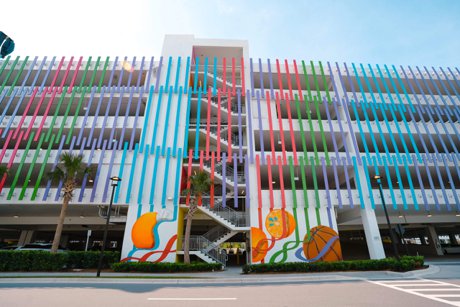
The DNA Garage is a four-story parking garage in Lake Nona Town Center, unveiled in spring 2021, whose facade carries color-coded vertical bars representing the four bases of DNA. The bars are arranged to depict the genetic sequence of a Valencia orange. The DNA Mural, painted on the same garage, carries the idea further: lines from the garage fins turn into DNA helixes, then into oranges, basketballs and volleyballs. Carissa Bloemeke of Tavistock Development Company designed the mural and Eduardo Smet painted it in spray paint. The garage is the second in a series of Town Center garages themed on coded languages, after the binary-code Code Wall by the Beacon. It is free to view from the street.
Most parking garages are designed so you forget them as soon as you find a space. Lake Nona built one you are supposed to read. The colored bars running up the side of the DNA Garage are letters, and the word they spell is an orange.
Plenty of people drive past it on the way to a workout at the Performance Club next door without knowing that. Fewer know that the mural painted on the garage is a separate piece by a different team, or that the orange Lake Nona picked is the variety scientists chose when they first mapped the sweet orange genome. That last part is not in any of the official descriptions. It is the best reason to stop and look.
What is the DNA Garage Mural?
The DNA Garage Mural is two pieces of public art on one building: a garage facade of color-coded bars that encode an orange's DNA, and a spray-painted mural that turns those bars into helixes, oranges and sports balls.
People use the names interchangeably, and Lake Nona itself calls the painted piece the DNA Garage mural in its public art roundups. The distinction matters if you want to know who made what. The garage facade is part of the building itself, a Tavistock Development Company concept. The mural was concepted and designed by Tavistock senior graphic designer Carissa Bloemeke and painted by Eduardo Smet, and Lake Nona describes it as the piece that “realizes” the facade's color sequencing. Read it as the garage's explanatory footnote, drawn instead of written.
| Location | Lake Nona Town Center, beside the Lake Nona Performance Club |
|---|---|
| Listed address | 6887 Marwick Lane, Orlando, FL 32827 |
| Garage unveiled | Spring 2021 |
| Mural painted | [VERIFY: year the DNA Mural was painted] |
| Mural design | Carissa Bloemeke, Tavistock Development Company |
| Mural painting | Eduardo Smet, spray paint |
| Also on site | Tile mosaic of an orange tree painting by Jennyfer Mancino, along the main staircase |
| Admission | None; viewed from the street and sidewalk |
What do the colored bars on the DNA Garage mean?
Each color stands for one of the four bases that hold a DNA double helix together, and the bars are arranged to show part of a Valencia orange's genetic sequence.
DNA is written in a four-letter alphabet: adenine, thymine, cytosine and guanine. The garage assigns each of those bases a color, drawn from the reds, blues, purples and greens Lake Nona already uses across Town Center, so the facade doubles as a legible strand of code. The bars are not all the same length. Each one sticks out from the building by a different amount, which is what gives the facade the shape of a wave.
One honest limit: the building is a sample, not the whole book. The sweet orange genome is estimated at about 367 million base pairs. A garage facade holds a sliver of that, and Lake Nona has not published which stretch of the sequence the bars reproduce, so nobody can walk up and check the spelling.
Why did Lake Nona choose a Valencia orange?
The official reason is Florida pride: the orange is the state fruit, and the Valencia is a variety that does well in Florida. The better reason is that the Valencia is the orange science actually decoded.
When Tavistock explained the choice in 2021, the answer was about roots. In Tavistock's telling, the Valencia was first developed in California and then redeveloped in Florida, and the orange connects a new town to the state it grew out of. That is the answer in the official descriptions.
Here is the part none of them mention. When a team led by researchers at Huazhong Agricultural University in China published the draft genome of the sweet orange in Nature Genetics in 2013, the plant they sequenced was a Valencia. It remains a standard reference in citrus genome databases. So the garage is not showing a generic orange. It is showing the variety that became science's reference sweet orange, in a community whose reason for existing is Medical City and the research labs around it. Whether the designers knew that or got lucky, the choice holds up to a scientist's scrutiny.
There is a sadder layer too. The Valencia is still the backbone of what is left of Florida's orange industry: 7.5 million of the 12.2 million boxes USDA forecast for the state in April 2026. USDA's first forecast for that season, in January, pointed to Florida's smallest orange crop since 1930, after years of citrus greening disease and hurricane damage; the final July forecast came in somewhat higher, at 12.92 million boxes. A Lake Nona garage now carries the code of a fruit that Central Florida grows far less of than it once did.
Who designed and painted the DNA Mural?
Carissa Bloemeke, a senior graphic designer at Tavistock Development Company, conceived and designed the mural, and Eduardo Smet painted it in spray paint.
That in-house authorship sets it apart. Several of Lake Nona's best-known pieces come from artists with international careers, such as Tom Fruin's Glass House in Laureate Park. Bloemeke is the developer's own designer who paints on the side, and her work is all over Town Center: she designed the Prismatic mural on the chiller plant and the Brain Freeze mural on the Pixon apartments. Smet has painted in Town Center too; he, Bloemeke and Jennyfer Mancino are among the artists behind its painted utility boxes.
The mural itself is the surreal half of the project. Lines seem to spill off the garage's vertical fins, twist into double helixes, and then break apart into floating Valencia oranges, basketballs and volleyballs. The balls are a nod to the building next door, the Lake Nona Performance Club, which the garage also serves with overflow parking.
The third artist on site is easy to miss. Tavistock commissioned local painter Jennyfer Mancino for an original painting of an orange tree, and an oversized tile-mosaic reproduction runs along the garage's main staircase. It uses a tile technique similar to the one at Canvas Restaurant & Market in Laureate Park.
What makes the DNA Garage Mural unique to Lake Nona?
It is one chapter of a deliberate series: Lake Nona's Town Center garages are each built around a different coded language, and this one is the language of life.
The first garage, the one wrapped around the Beacon, carries the Code Wall, glass panels etched with messages in binary. Tavistock's Juan Santos described the DNA Garage as the sequel: the first garage explored the language of computers, and this one explores the language of life. The two are near twins underneath, four stories each with the same layout and function. The art is what tells them apart.
That is what separates this from a mural you could find in any downtown arts district. A garage covered in binary and a garage covered in genetic code only make sense side by side in a community built on health research and technology. Put the DNA Garage in a suburban shopping center and it becomes a pretty paint job. In Lake Nona Town Center, a short distance from the teaching hospitals and research buildings of Medical City, it reads as a statement of what the place is for.
Tavistock said in 2021 that future garages would continue the language theme. We have not found a third language garage announced since, so for now the series is two buildings long.
How do you see the DNA Garage Mural?
Drive to Town Center, park in the garage itself, and walk around the outside: the facade and mural are best seen from the street, and the mosaic is at the main staircase.
Walk the length of the facade: the varying depth of the bars is what makes the wave, and the color sequence is easiest to follow up close. Then find the painted wall where the lines leave the fins and turn into helixes and fruit.
It is a short stop, so pair it. The Beacon and Code Wall are the obvious companion, since the two garages are meant to be read together, and the rest of Town Center's art is walkable from there. Our walking guide to Lake Nona's murals and installations strings the pieces into one loop, and the Lake Nona Sculpture Garden is the natural finish. For everything else, see our Lake Nona arts and culture hub.
The Honest Version: Pros, Cons and Our Take
Pros
- Free, outdoors and visible any time you are in Town Center.
- A real idea behind it, not decoration: the genetic code of the orange variety science uses as its reference genome.
- Pairs with the Code Wall to make a two-building story you can explain to visitors in a minute.
- Designed in-house by the developer's own designer, which shows in how closely it ties to the buildings around it.
Cons
- It is a parking garage. You are viewing it from sidewalks and drive aisles, with traffic moving past.
- The code is not readable. Without the published sequence, the DNA is a concept you take on faith rather than something you can decode on site.
- It is a short stop, not an outing. Do not drive across Orlando for it alone.
- Outdoor spray paint in Florida sun needs upkeep.
Our Take: See it as half of a pair. Start at the Beacon and Code Wall, walk to the DNA Garage, and the idea behind both lands in a way neither makes on its own. If you only have time for one Town Center landmark, the Beacon is the bigger show. If you want the one that says the most about why Lake Nona exists, it is this garage.
What the Neighbors Know
For people who live here, the DNA Garage is less a landmark than a place to park, and that is exactly the point Lake Nona was making.
Residents mostly meet it on the way to the gym, an office or dinner in Town Center, which is how Tavistock designed its art program: pieces built into buildings people use every day rather than set apart behind a gallery door. It is also a fair preview of living here. Across the Lake Nona neighborhoods, the community has spent years putting research, health and design into places most developers would leave blank, from the chiller plant to the parking decks. Whether that appeals to you is a good test of whether Lake Nona fits.
Official Sources
- Lake Nona: DNA Garage
- Lake Nona: DNA Mural
- Lake Nona: Language of Life (2021 Q&A on the garage)
- Nature Genetics: The draft genome of sweet orange (2013)
- Central Florida Ag News: USDA 2025-26 Florida citrus forecast
Thinking about living near Town Center and Medical City? Call/Text David Myers at 407.801.3286 or use the contact form. And no, I'm not going to blow up your phone. I've got enough to do (and so do you).
Frequently Asked Questions
Where is the DNA Garage Mural in Lake Nona?
It is on the DNA Garage in Lake Nona Town Center, next to the Lake Nona Performance Club. Lake Nona lists the garage at 6887 Marwick Lane, Orlando, FL 32827.
What DNA is on the DNA Garage?
The colored bars represent the four bases of DNA, arranged to depict the genetic sequence of a Valencia orange. Lake Nona has not published which stretch of the orange's genome the facade shows.
Who designed and painted the DNA Mural?
Carissa Bloemeke, a senior graphic designer at Tavistock Development Company, conceived and designed it. Eduardo Smet painted it in spray paint.
Why are there basketballs and volleyballs in the mural?
They point to the building next door, the Lake Nona Performance Club at One Performance Plaza.
Is the DNA Garage connected to the Code Wall?
Yes, by theme. The Code Wall garage by the Beacon uses binary code, the language of computers; the DNA Garage was designed as its follow-up, using the language of life.
Does it cost anything to see the DNA Garage Mural?
No. It is public art on the outside of a parking garage, visible from the street and sidewalk in Town Center.