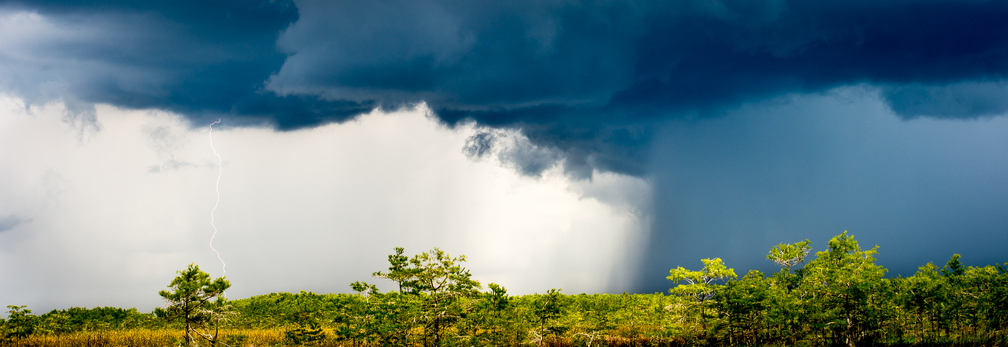
Two seasons, one umbrella. Lake Nona has a long, wet summer and a short, dry, pleasant winter, and the calendar line between them is surprisingly sharp.
Lake Nona's weather runs on two seasons: a hot, wet summer and a mild, dry winter. National Weather Service normals for Orlando International Airport, next door to Lake Nona, show July highs of 92 degrees and January highs of about 72. The area averages 51.45 inches of rain a year, and more than half of it falls from June through September. The weather service puts Orlando's median wet-season start at May 27 and dry-season start at October 15. Summer storms bring frequent lightning, so the standard rule here is to go indoors at the first thunder and wait 30 minutes after the last.
Out-of-state buyers ask about the weather more than almost anything except the commute. The short answer is that Lake Nona feels like two different places depending on the month, and the numbers below explain why.
All of the figures come from the National Weather Service office in Melbourne, which keeps the official climate record for Orlando at Orlando International Airport. The airport sits on Lake Nona's northern doorstep, so its record is as close to a Lake Nona thermometer as official data gets. "Normal" here means the 1991-2020 average the weather service uses.
What is the weather like in Lake Nona?
Warm most of the year, hot and rainy in summer, and mild and dry in winter.
The yearly normal high at the airport is 83.2 degrees and the yearly normal low is 62.7. Rain totals 51.45 inches in a normal year, but it does not arrive evenly. The National Weather Service describes east central Florida as having a wet season and a dry season, and in Orlando the median dates are May 27 for the start of the wet season and October 15 for the start of the dry season.
In practice, that means about four and a half months of afternoon storms and seven and a half months of mostly dry, sunny weather. Neither season resembles a northern winter or a northern summer, which is the adjustment most newcomers have to make.
How hot does Lake Nona get in summer?
Normal highs sit in the low 90s from June through August, and nights stay in the low 70s.
July is the hottest month, with a normal high of 92.0 degrees and a normal low of 73.2. August is nearly identical at 91.6 and 73.7, June runs 90.8 and 71.6, and September is still 89.6 and 72.4. The summer average (June through August) is a high of 91.5 and a low of 72.8.
The number on the thermometer is only part of it. Summer nights rarely cool off much, and the humidity makes the low 90s feel heavier than the same reading in a dry climate. The record books at the airport, which go back to the late 1800s, show summer highs of 101 degrees on several days, most recently July 2, 1998. A normal Lake Nona summer is hot every day rather than extreme on a few.
When is the rainy season, and what does it look like?
Late May to mid-October, and it usually arrives as a short, heavy afternoon storm rather than an all-day rain.
June is the wettest month, with a normal of 8.05 inches, followed by August at 7.69, July at 7.46 and September at 6.37. Those four months add up to 29.57 inches, more than half of the annual total. November is the driest month at 1.79 inches.
The weather service explains the pattern through the sea breezes. On summer afternoons, breezes from the Atlantic and the Gulf push inland and collide over the middle of the peninsula, which is where Lake Nona sits. That collision builds the tall afternoon thunderstorms that define a Central Florida summer. Mornings are often clear, the storm rolls through in the afternoon or early evening, and the streets are steaming dry again by dinner.
Hurricane season, June 1 through November 30, overlaps the wet season. It gets its own guide: see hurricane season in Lake Nona and our guide to flood zones and flood insurance.
How common is lightning in Lake Nona?
Very. The National Weather Service calls central Florida the lightning capital of the United States.
The weather service's Melbourne office says lightning causes more weather-related deaths in Florida than all other weather hazards combined, and that Florida has the most lightning casualties of any state. Its Florida lightning climatology names July as the peak month, with June and August close behind, and December as the quietest.
The safety rule is short: when thunder roars, go indoors. The weather service recommends staying under cover until 30 minutes after the last clap of thunder, because lightning can strike more than 10 miles from the center of a storm. A house or other large enclosed building is the safest place to be; a hard-topped car is the backup. A covered pavilion, a golf cart or a tree is not shelter.
This matters in a community built around the outdoors. If you plan to spend summer afternoons on the trails, at the parks, on the golf course or on the water at Lake Hart, plan the outing for the morning and keep an eye on the sky after lunch.
What does each month look like?
Here are the official 1991-2020 normals for Orlando International Airport, month by month.
| Month | Normal high (F) | Normal low (F) | Normal rain (in) |
|---|---|---|---|
| January | 71.8 | 49.5 | 2.48 |
| February | 74.9 | 52.4 | 2.04 |
| March | 78.9 | 55.8 | 3.03 |
| April | 83.6 | 60.7 | 2.58 |
| May | 88.4 | 66.3 | 4.02 |
| June | 90.8 | 71.6 | 8.05 |
| July | 92.0 | 73.2 | 7.46 |
| August | 91.6 | 73.7 | 7.69 |
| September | 89.6 | 72.4 | 6.37 |
| October | 84.7 | 66.2 | 3.46 |
| November | 78.3 | 58.2 | 1.79 |
| December | 73.8 | 52.9 | 2.48 |
| Year | 83.2 | 62.7 | 51.45 |
Spring (March through May) is dry and warms quickly; May is already in the upper 80s before the rain starts. Fall (September through November) cools slowly, and the dry season typically begins in mid-October.
How cold does winter get?
Mild. January is the coolest month, with a normal high of 71.8 degrees and a normal low of 49.5.
December, January and February average a high of 73.5 and a low of 51.6. The weather service puts Orlando's median first night below 60 degrees on October 19 and its first night below 50 on November 5. Cold fronts do push through, and the airport's January records include a low of 19 degrees on January 21, 1985, so a freeze is possible, just rare.
Winter is also the dry season. December through February bring a normal of 7.00 inches of rain combined, less than June alone. It is the stretch when Lake Nona's outdoor events, from the festivals and markets to the long walks on the trail network, are at their most comfortable.
What does the climate mean for a Lake Nona home?
The air conditioner does most of the work, and the roof, gutters and drainage do the rest.
The airport's annual normals show 3,452 cooling degree days against 525 heating degree days. In plain terms, homes here need cooling many times more than heating, so the age and efficiency of the AC system matters more than the furnace. Ask about the age of the system during your home inspection, and expect the summer electric bills to be the highest of the year. Our utilities guide lists who provides service.
The rain matters too. Heavy afternoon downpours test gutters, downspouts and lot drainage several times a week in summer, so look at where the water goes during a showing if you can. And if a pool home is on your list, the long swimming season is the main reason to buy one; our pool cost guide covers the upkeep.
Pros, Cons and Our Take
Pros
- Winters are mild and dry, with normal highs in the low to mid 70s
- Outdoor living works most of the year
- Summer storms are usually short and come at predictable times of day
Cons
- Normal highs are in the 90s for three months, with high humidity
- Frequent lightning from late spring through early fall
- Higher cooling bills in summer
- Hurricane season overlaps the wet season
Our Take
Lake Nona's weather suits people who would rather plan around an afternoon storm than shovel a driveway. Do one visit in July or August before you commit. If you still like it after a week of 92 degrees and a 4 p.m. downpour, the other eight months will feel like a reward.
What the Neighbors Know
Long-time residents run, walk the dog and play tennis early in summer and save errands for the afternoon storm. They keep an umbrella in the car from May to October, and they leave the pool when the first thunder rumbles, not when the rain starts. Winter is when the calendar fills up, so expect the trails, the patios and Town Center to be busiest from November through April.
Official Sources
- National Weather Service Melbourne — 1991-2020 Climate Normals
- National Weather Service Melbourne — Orlando (MCO) July Climate Summary
- National Weather Service Melbourne — Orlando (MCO) December Climate Summary and Yearly Normals
- National Weather Service Melbourne — Wet and Dry Season Onset
- National Weather Service Melbourne — Florida Lightning Climatology
- National Weather Service Melbourne — Lightning Safety
Planning a move to Lake Nona and want to see it in the heat of summer first? Call/Text David Myers at 407.801.3286 or use the contact form.
Frequently Asked Questions
What is the hottest month in Lake Nona?
July. The 1991-2020 normal high at Orlando International Airport, the official Orlando weather station next door to Lake Nona, is 92.0 degrees in July, with August close behind at 91.6.
When is the rainy season in Orlando and Lake Nona?
The National Weather Service puts the median start of the wet season in Orlando at May 27 and the start of the dry season at October 15. June is the wettest month, with a normal of 8.05 inches.
How much rain does Lake Nona get in a year?
About 51 inches. The annual normal at Orlando International Airport is 51.45 inches, and June through September account for more than half of it.
Does it get cold in Lake Nona?
Not for long. January is the coolest month, with a normal high of 71.8 degrees and a normal low of 49.5. The weather service puts Orlando's median first night below 50 degrees on November 5.