Tom Fruin's walk-in "stained glass" house on the water at Laureate Park: what it's made of, where the idea came from, and why it has become the backdrop people pick when they want a Lake Nona photo.
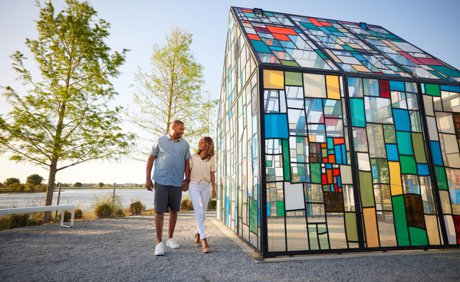
The Glass House is a walk-in public sculpture by Brooklyn artist Tom Fruin, installed in early 2016 beside Canvas Restaurant & Market in the Laureate Park village center. It is built from salvaged colored plexiglass in a steel frame, not from glass. It belongs to Fruin's ICON series, which began in 2010 with Kolonihavehus, a garden-house sculpture first shown in Copenhagen. The piece is lit from inside after dark. It is outdoor public art with no admission listed, at 13615 Sachs Avenue, Orlando, FL 32827.
Everybody knows the rule about people who live in glass houses. Laureate Park gets a pass on that one: its glass house isn't glass. It's salvaged plastic that happens to look like a chapel window, and it has spent the last ten years quietly turning into the most photographed thing in the neighborhood.
If you've had dinner at Canvas Restaurant & Market, you've seen it glowing at the water's edge. Most people who walk past it couldn't tell you who made it or why it's shaped like a shed. Here's the backstory, including a couple of things the official descriptions leave out.
What is the Glass House in Lake Nona?
The Glass House is a walk-in sculpture by Brooklyn artist Tom Fruin: a small house shape paneled in salvaged colored plexiglass that reads as stained glass.
It has the simplest possible house silhouette, a square base under a pitched roof, and it sits on the bank of the lake in the Laureate Park village center, next door to Canvas. Lake Nona's own description calls it site-specific and monumental, built from reclaimed materials, and drawing on sustainable urban design, American folk art and the spiritual feel of stained glass. Translated out of gallery language: Fruin takes the plainest building a place has, rebuilds it out of scrap, and lets the light do the rest.
| Artist | Tom Fruin (born 1974, Los Angeles; works in Brooklyn) |
|---|---|
| Series | ICON, which began with Kolonihavehus in Copenhagen in 2010 |
| Installed | Early 2016 |
| Materials | Salvaged colored plexiglass in a steel frame |
| Location | Laureate Park village center, beside Canvas Restaurant & Market |
| Listed address | 13615 Sachs Avenue, Orlando, FL 32827 |
| Admission | None listed; outdoor public art |
Is the Glass House actually made of glass?
No. The Glass House is plexiglass (acrylic), cut from salvaged scraps and set in a steel frame, which is how Fruin builds every piece in the series.
This is the most common misconception about it, and the name doesn't help. Fruin's large outdoor works are consistently steel and brightly colored plexiglass. The material choice is practical as much as artistic: acrylic is far lighter than glass, it doesn't shatter into shards, and it takes color all the way through, which is why the piece still glows from inside rather than just reflecting.
One thing worth being honest about: the sourcing story you'll read for Fruin's work comes from his first house. For that one, in Copenhagen, the plexiglass was gathered from a plexiglass distributor that had gone out of business, a picture-framing shop that was closing, the basement of the Danish State Art Workshops, and the dumpsters behind the Danish Architecture Center. Where the Lake Nona panels came from hasn't been published. Reclaimed material is the rule of the series, not a documented detail of this particular piece.
Where did the idea for the Glass House come from?
The Glass House descends from a Danish garden shed: Fruin's ICON series started with Kolonihavehus, built in Copenhagen in 2010.
A kolonihavehus is the small garden hut you see all over Copenhagen's allotment gardens, originally meant to give city workers a refuge from cramped apartments. Fruin rebuilt one out of roughly a thousand plexiglass scraps, with a pivoting door on handmade hinges and windows that actually open, and stood it in the plaza of the Royal Danish Library in the fall of 2010. It then toured Aalborg, Prague, Helsingør and Vienna before crossing to Brooklyn.
That piece set the formula: take a humble, everyday building type, one so common people stop seeing it, and remake it as something you can't walk past. In New York the everyday building was a rooftop water tank; Fruin's Watertower went up on a rooftop in DUMBO in 2012 and became a fixture of the Brooklyn skyline. By 2022 the series ran to dozens of pieces. Lake Nona's version went back to the original form, a house.
How was the Glass House built?
Fruin builds these pieces from individually framed plexiglass scraps welded into a steel "quilt," then assembles that quilt into a building shape.
The quilt comparison is his, and it's literal. Before the ICON series, Fruin was known for quilts and flags stitched together from found scraps; the houses are those quilts turned three-dimensional. Each scrap gets its own steel frame, the frames are welded to each other, and the panel pattern ends up echoing a city grid while the colors run wherever the salvage takes them. No two panels match, which is the point.
The Lake Nona piece went up in early 2016. A local blog covering the neighborhood at the time reported that it had been built "last week," standing next door to Canvas in the Laureate Park village center. Fruin's larger pieces are lit from within at night, and this one is too, which is why it reads so differently after sunset than it does at lunch.
How did the Glass House become a Lake Nona icon?
It became an icon the way most landmarks do: people kept choosing it as the place to stand in front of.
The evidence is mostly other people's cameras. Engagement photographers were bringing couples to it by 2017, including one couple who, after seeing photos of it, road-tripped to Lake Nona for their session because they couldn't find anything like it closer to home. Dockside Lake Nona lists it as a wedding ceremony location. When Foxtail Coffee opened inside Canvas, its own description of the space talked about the floor-to-ceiling windows framing the Glass House, as if the sculpture were part of the room. Lake Nona's official art tour and outside travel guides now list it as a stop in its own right.
There's a nice irony in the name of the series, too. The series is called ICON, and its pieces borrow buildings too ordinary to notice. The Lake Nona house has turned into an icon on its own terms.
When is the best time to see the Glass House?
Go at dusk, so you see it twice: throwing colored light across the ground in the last of the sun, then glowing from inside once it's dark.
In full daylight the panels cast colored patches on the pavement and on anyone standing inside, which is the version most daytime photos capture. After dark it becomes a lantern on the water, and that's the version most people remember. The simplest plan is to book a table at Canvas, eat, and walk over afterward. On a clear evening you may be waiting a minute for a photographer to finish; it's a popular spot for portraits and weddings.
How does the Glass House fit into Lake Nona's public art?
It's the anchor of the Laureate Park stretch of Lake Nona's public art, a short walk from the pieces around Town Center.
Lake Nona has built a real outdoor collection over the years, from The Beacon at Town Center to the Lake Nona Sculpture Garden. If you want to string them together, our walking guide to Lake Nona's murals and installations routes you through all of them, with the Glass House as the Laureate Park stop. The full picture lives on our Lake Nona arts and culture hub.
The Honest Version: Pros, Cons and Our Take
Pros
- Free, outdoor and walk-in, with no hours to plan around that we've seen published.
- Pairs naturally with dinner at Canvas or a coffee at the counter inside it.
- It genuinely changes between day and night, so a second visit isn't a repeat.
- Real provenance: part of a series whose first piece toured Copenhagen, Prague and Vienna, not a builder's decorative feature.
Cons
- It's one small room. A visit is fifteen minutes, not an afternoon, so don't drive across Orlando for it alone.
- Dockside books it for ceremonies, so on some evenings it's somebody's wedding and you'll be admiring it from a polite distance.
- Plexiglass ages outdoors. Fruin's first house needed cracked panes repaired after twelve years outside in Europe; this one has had ten years of Florida sun. [VERIFY: current condition of the Lake Nona panels, and whether any restoration has been done]
- The secret is out. Photographers use it for portraits and weddings, so expect company on weekend evenings.
Our Take: Make it the last stop of a Canvas dinner, arrive around sunset, and stay until the lights come up. As a standalone destination it's a short visit; as the end of an evening in Laureate Park it's the part your guests will photograph.
What the Neighbors Know
For people who live in Laureate Park, the Glass House is the walk-to landmark at the center of the neighborhood, not a day trip.
It sits in the Laureate Park village center, alongside Canvas and the lakefront, which means residents get it the way the rest of us get a favorite corner: on the way to dinner, on an evening walk, as the obvious place to take visiting family. That's the practical difference between visiting a landmark and living near one. Which brings us back to the proverb. If you live near this glass house, the move isn't throwing stones. It's walking your out-of-town guests over after dessert and taking the same photo everyone else does.
Official Sources
- Lake Nona: The Glass House
- Lake Nona Art Tour
- Tom Fruin Studio: Kolonihavehus
- Dockside Lake Nona: Weddings
Thinking about living within walking distance of the Glass House, or anywhere else in Laureate Park? Call/Text David Myers at 407.801.3286 or use the contact form. And no, I'm not going to blow up your phone. I've got enough to do (and so do you).
Frequently Asked Questions
Where is the Glass House in Lake Nona?
It sits in the Laureate Park village center, on the water beside Canvas Restaurant & Market. Lake Nona lists the address as 13615 Sachs Avenue, Orlando, FL 32827.
Is the Glass House made of real glass?
No. It is built from salvaged colored plexiglass set in a steel frame, which gives the look of stained glass without the weight or fragility of glass.
Who made the Glass House, and when?
Brooklyn-based sculptor Tom Fruin. It went up in early 2016 as part of his ICON series of building-shaped sculptures.
Can you go inside the Glass House?
Yes. It is a walk-in piece, but it is one small room, so plan on a short visit rather than an outing of its own.
Does it cost anything to see the Glass House?
No admission is listed. It is an outdoor public art piece in the village center, open to anyone passing through.
Can you get married at the Glass House?
Dockside Lake Nona lists the Glass House as a wedding ceremony location, so ceremonies there are arranged through Dockside rather than informally.