Lake Nona › Blog Nona › Nona Tech/Innovation › Verizon 5G Innovation Hub
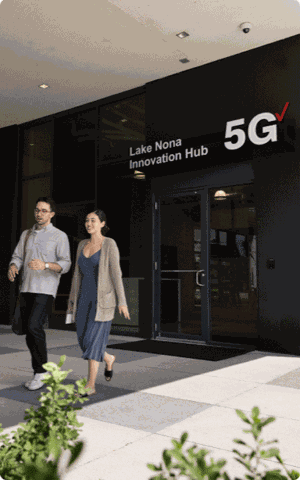
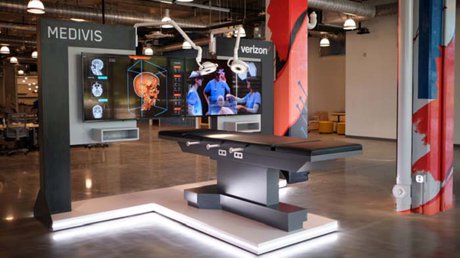 In a world that runs on connection, few technologies have created more buzz—and more potential—than 5G. But while most of the world has been content to talk about what 5G might enable, one place has been busy testing what it actually can do. That place is Lake Nona, and at the center of its next-generation infrastructure is the Verizon 5G Innovation Hub.
Located within Lake Nona’s growing tech corridor, the Verizon 5G Innovation Hub was officially unveiled in late 2021 as a part of Verizon’s broader push to roll out ultra-fast wireless connectivity across the U.S. It was not the company’s first 5G innovation site—but it quickly became one of the most important. That’s because Lake Nona offers something that most cities can’t: a purpose-built environment with smart city infrastructure, a high concentration of health and technology companies, and a community actively engaged in building the future.
The Innovation Hub was created as a place for companies, startups, researchers, and developers to test and deploy 5G applications in real-world conditions. It’s more than just a lab—it’s a launchpad for the next wave of tech products and services, made possible by the speed, low latency, and massive bandwidth that 5G enables.
To understand why this matters, it helps to understand what 5G really is. The fifth generation of wireless technology, 5G offers download speeds up to 100 times faster than 4G, and latency (the time it takes for data to travel from source to destination) that’s measured in milliseconds. That means devices can talk to each other almost instantly—enabling everything from autonomous vehicles to smart hospital systems to immersive augmented reality.
And those are exactly the kinds of applications being tested at the Verizon 5G Innovation Hub.
When Verizon selected Lake Nona as one of its Innovation Hub sites, it was already investing heavily in building out 5G Ultra Wideband coverage across the community. That infrastructure gave Verizon a unique opportunity: to study how 5G performs not in a controlled lab, but in a living, breathing city designed with digital integration in mind. Lake Nona’s smart lighting, autonomous shuttles, connected buildings, and health-focused institutions made it a natural sandbox for emerging tech.
The Hub itself is a sleek, modern workspace equipped with the latest wireless hardware, prototyping tools, edge computing capabilities, and collaboration spaces. But the real magic happens in what the Hub enables. Companies working out of the Hub have access to Verizon’s 5G infrastructure, cloud services, IoT platforms, and developer tools. That means they can build and test solutions that require real-time data transfer, low-latency response, and massive device connectivity—all critical to industries like health tech, smart cities, logistics, and entertainment.
In the months following its launch, the Hub quickly began drawing attention from a diverse range of innovators. Health tech firms began exploring how 5G could support remote surgery, real-time patient monitoring, and high-resolution telehealth. Transportation companies studied how autonomous vehicles could better communicate with their environments. Startups began using 5G to power augmented and virtual reality tools for training, diagnostics, and design.
Even sports and fitness got in on the action. With Lake Nona’s emphasis on human performance and wellness, several pilot programs have tested wearable technologies that stream real-time biometric data over 5G networks—data that can be analyzed on the edge and visualized instantly for athletes, coaches, and researchers.
The Hub has also played a role in education. Through partnerships with local institutions and national organizations, Verizon has used the Lake Nona site to demonstrate the educational potential of 5G. That includes immersive learning experiences, virtual science labs, and career training simulations that can be accessed via mobile devices or VR headsets. These projects have particular importance for underserved communities where access to physical labs or infrastructure might be limited.
Another critical area of focus has been smart buildings and urban infrastructure. Several of the buildings surrounding the 5G Hub are equipped with sensors and control systems that can communicate via 5G to optimize lighting, energy usage, air quality, and security. These systems form the backbone of what’s known as “intelligent infrastructure,” where buildings effectively monitor and manage themselves—reducing energy costs, extending equipment lifespan, and creating more responsive environments for occupants.
 The Hub also serves as a field testing site for advanced robotics. 5G’s low latency allows robots to be controlled remotely in near real-time, making it feasible for companies to explore use cases in automated delivery, warehouse operations, and even healthcare environments. Several pilot programs have explored how 5G-connected robots can assist with cleaning, deliveries, and patient interactions in clinical settings—especially valuable in times when reducing human exposure to pathogens is a concern.
What makes the Verizon 5G Innovation Hub in Lake Nona especially valuable is the ecosystem around it. Unlike many other test sites, where the surrounding environment is either industrial or purely academic, Lake Nona offers a highly dynamic real-world environment. People live, work, and learn here. The Innovation Hub can draw from a wide base of actual users—patients, doctors, teachers, athletes, business owners—giving developers real-time feedback on their products and ideas.
From Verizon’s standpoint, the Lake Nona Hub offers a showcase for what’s possible when infrastructure and innovation are aligned. It’s not just about demonstrating what 5G can do—it’s about proving it in a community where those innovations can scale. That real-world application is critical to Verizon’s strategy as it expands its business offerings beyond consumer mobile into enterprise services and industry-specific solutions.
The company has made it clear that the Innovation Hub isn’t a temporary installation—it’s part of a long-term commitment to Lake Nona and to accelerating the pace of digital transformation across industries. Verizon continues to invest in 5G infrastructure upgrades, partnerships with local and national businesses, and new service rollouts that will be tested in Lake Nona before scaling nationally.
The success of the Innovation Hub has also inspired conversations around expanding the concept. There are plans to increase the size of the test environment by integrating more of Lake Nona’s public spaces, transportation routes, and institutional facilities into live 5G testbeds. These expanded testing grounds would allow for more comprehensive trials of smart city technologies, connected mobility systems, and citywide digital services.
Looking to the future, the Verizon 5G Innovation Hub is expected to play a role in some of the most important technology developments of the next decade. These include connected healthcare ecosystems where patient data is continuously updated across devices and providers; autonomous transportation networks where vehicles and infrastructure communicate seamlessly; and consumer applications that blend physical and digital reality in ways we’re only beginning to imagine.
At the same time, the Hub is helping Lake Nona refine its identity. Already known for medical innovation and wellness-focused planning, the community is now gaining recognition as a hub for telecom and digital infrastructure testing. That kind of diversification strengthens Lake Nona’s position as not just a health and wellness destination—but a city built on the leading edge of multiple industries.
And while 5G may be the headline technology today, the real story here is bigger. The Verizon 5G Innovation Hub is about building the connectivity foundation for everything that comes next: smarter cities, faster diagnostics, real-time learning, immersive entertainment, and more resilient infrastructure. It’s about preparing for the next chapter in the digital revolution—and making sure that Lake Nona is not only part of that story but helping write it.
More details on their official site at: https://www.verizon.com/business/why-verizon/5g-innovation-hub-program/lake-nona/