Lake Nona sits inland, but a Florida policy is still priced on the roof, the wind form and the deductible you choose.

Insurance is one of the few Lake Nona closing costs that changes from one house to the next on the same street, because Florida insurers price each home on its own roof, its wind protection and the deductible the buyer picks. Florida law bars an insurer from refusing to issue or renew a policy solely because a roof is less than 15 years old. A wind mitigation inspection on the state's OIR-B1-1802 form documents the features insurers use for discounts and is valid for up to five years. Hurricane deductibles are set as a flat $500 or as 2, 5 or 10 percent of the dwelling limit, and apply once per calendar year. Flood damage is not covered by a standard homeowners policy, and Citizens Property Insurance now requires flood coverage on almost all of its policies, reaching every policy on January 1, 2027.
Out-of-state buyers tend to ask about insurance after they ask about schools and commute times. In Florida it belongs near the top of the list, because the lender will not fund the loan without a policy in place, and the premium can move a monthly payment as much as a CDD or HOA can.
Here is how a Florida homeowners policy works on a Lake Nona house, which documents change the price, and where the official rules are written down.
When should a Lake Nona buyer start shopping for insurance?
Start during the inspection period, before the deposit becomes hard to get back, because the quote depends on the specific house.
A lender needs proof of homeowners coverage before closing. Two Lake Nona homes with the same floor plan can quote differently if one has a newer roof, a current wind mitigation form or impact-rated openings and the other does not. Asking the seller for the roof permit date and any existing wind mitigation report on day one gives an agent something real to quote.
The insurance premium is part of the monthly cost picture alongside the property tax bill, any CDD assessment and HOA dues. We put all of them side by side before a buyer commits.
Does the age of the roof affect insurance in Florida?
Yes, but Florida law limits how far it can go: an insurer may not refuse to issue or renew a policy solely because the roof is less than 15 years old.
Section 627.7011 of the Florida Statutes sets the rule. For a roof that is at least 15 years old, the insurer must let the homeowner have the roof inspected by an authorized inspector, at the homeowner's expense, before requiring replacement. If that inspection shows the roof has 5 years or more of useful life left, the insurer may not refuse to issue or renew solely because of the roof's age. The rule applies to policies issued or renewed on or after July 1, 2022.
The law limits refusals based on age alone. It does not stop an insurer from pricing a roof's age and condition into the premium, so a newer roof can still quote lower.
On a resale, the year the roof was installed matters more than the year the house was built. The permit record answers that question. Some insurers also ask for a four-point inspection on older homes, which looks at the roof, electrical, plumbing and heating and cooling systems.
What is a wind mitigation inspection, and why does it matter?
It is an inspection recorded on Florida's OIR-B1-1802 form that documents a home's wind-resistance features, and insurers use it to apply wind mitigation discounts.
The form covers items such as roof covering, roof-to-wall connections and opening protection. According to the Florida Department of Financial Services, a completed form is valid for up to five years if no material changes are made to the structure, and the revised version, OIR-B1-1802 (Rev. 04/26), must be used for all inspections as of April 1, 2026.
Licensed home inspectors, building code inspectors, contractors, professional engineers and architects can sign it. Admitted insurers must also send a Notice of Premium Discounts for Hurricane Loss Mitigation with each new policy and at every renewal, which lists the features that can earn a discount.
Many Lake Nona sellers already have a form from their own policy. Ask for it. If it is recent and nothing has changed, it can go straight to the buyer's agent for quoting.
How do hurricane deductibles work in Florida?
Florida sets the menu: $500, or 2, 5 or 10 percent of the policy's dwelling limit, and the hurricane deductible applies once per calendar year.
The percentage is taken from the policy's dwelling limit, not from the size of the claim, so a 2 percent deductible on a $500,000 dwelling limit is $10,000. The Florida CFO lists exceptions by dwelling value. Among them: on a dwelling insured for $250,000 or more, the insurer does not have to offer the $500 option, but must offer 2, 5 and 10 percent. Dwellings insured between $1 million and $3 million may be offered 3, 5 and 10 percent instead.
The hurricane deductible applies to covered losses from the time the National Hurricane Center issues a hurricane warning for any part of Florida until 72 hours after the last hurricane watch or warning ends. It applies on an annual basis to all covered hurricane losses in a calendar year, as long as the homeowner stays with the same insurer or an insurer in its group.
A lower premium often comes with a higher deductible. Pick the deductible you could pay out of savings after a storm, not the one that makes the quote look smallest.
Does homeowners insurance cover flooding in Lake Nona?
No. FEMA notes that homeowners insurance does not typically cover flood damage, so flood coverage is a separate policy.
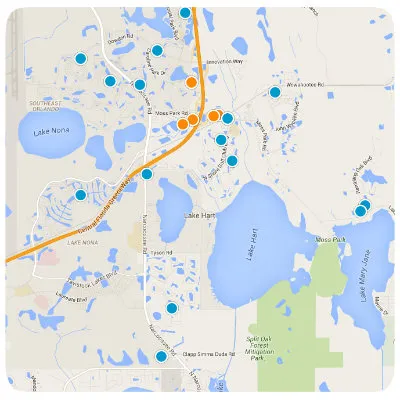
Lake Nona is inland, so storm surge is not the issue. Rain is. The neighborhoods are built around Lake Nona, Lake Hart, Lake Mary Jane and a network of retention ponds, and heavy tropical rain is what fills them.
Your lender will tell you whether the home's flood zone makes a flood policy a loan condition. Either way, FEMA says most flood policies have a 30-day waiting period before they take effect. The waiting period does not apply when the flood policy is bought in connection with making, increasing, extending or renewing a mortgage loan, which is why the time to decide is before closing.
When does Citizens Property Insurance come into it?
Citizens is Florida's state-created insurer, and a home generally qualifies only when no Florida-authorized insurer offers coverage or those premiums are more than 20 percent higher than comparable Citizens coverage.
Citizens policies are sold only through appointed Citizens agents. Citizens also requires most homes with wind coverage to carry flood insurance, on a schedule tied to the dwelling value (Coverage A):
| January 1, 2024 | Dwelling value of $600,000 or more |
|---|---|
| January 1, 2025 | Dwelling value of $500,000 or more |
| January 1, 2026 | Dwelling value of $400,000 or more |
| January 1, 2027 | All policies, regardless of value |
New applicants and renewing policyholders both have to submit proof of flood coverage. Condominium unit-owner policies and policies that exclude windstorm coverage are exempt. A buyer closing in late 2026 who lands with Citizens should budget for a flood policy from the start.
Can the My Safe Florida Home program help a Lake Nona owner?
It can help some owners, but the hurricane mitigation grant requires a homesteaded, site-built, owner-occupied home built before January 1, 2008.
My Safe Florida Home offers free hurricane mitigation inspections to homeowners who have a homestead exemption on a site-built, owner-occupied single-family home. The grant has more conditions: the home must have been built before January 1, 2008 according to the county property appraiser's website, and the insured value must be $700,000 or less. The program pays $2 for every $1 the homeowner contributes, up to a $10,000 state contribution, and low-income grants of up to $10,000 need no match.
Much of Lake Nona's newer construction falls after that cutoff; Summerdale Park, for example, was built from 2022 to 2024. Check the year built on the Orange County Property Appraiser record before counting on a grant. The program says applications open in phases, with dates posted on its website.
Pros, Cons and Our Take
Pros
- Florida law limits refusals based on roof age alone
- A current wind mitigation form can lower the premium and stays valid for up to five years
- No storm surge risk in inland Lake Nona
- Hurricane deductible choices are set by state law
Cons
- Premiums vary house by house, so a quote from a neighbor tells you little
- Flood coverage is a separate policy with its own cost
- Citizens now requires flood coverage on nearly all of its policies
- Homes built in 2008 or later do not qualify for a My Safe Florida Home grant
Our Take
Insurance in Lake Nona is a per-house number, not a per-neighborhood number. Get the roof date and the wind mitigation form early, quote it during the inspection period, choose a deductible you can actually pay, and decide on flood coverage before closing, not after the first big storm.
What the Neighbors Know
Owners who have been here a while ask two questions about any house: how old is the roof, and is there a wind mitigation form. Those two answers move a quote more than the address does, whether the home is in Laureate Park, Eagle Creek or any other Lake Nona neighborhood.
For the rest of the monthly cost picture, see our guides to CDD fees and utilities and community contacts, and browse new construction homes if a new roof is high on your list.
Official Sources
- Section 627.7011, Florida Statutes — roof age provisions (2024 text)
- Florida CFO — Mitigation Notices, Inspections and Forms
- Florida CFO — Florida's Hurricane Deductible
- FEMA — Don't Wait: Buy Flood Insurance Today
- Citizens Property Insurance — Get a Policy
- Citizens Property Insurance — Flood Insurance Requirement
- My Safe Florida Home — Frequently Asked Questions
Buying or selling in Lake Nona? Call/Text David Myers at 407.801.3286 or use the contact form.
Frequently Asked Questions
Can a Florida insurer refuse to cover a home because of the roof's age?
Not if the roof is less than 15 years old. Section 627.7011 bars refusing to issue or renew solely because of roof age under 15 years, and a roof 15 or older cannot be refused on age alone if an authorized inspector finds 5 or more years of useful life left.
Does homeowners insurance cover flooding in Lake Nona?
No. Standard homeowners policies do not typically cover flood damage. Flood coverage is a separate policy, and most flood policies have a 30-day waiting period unless bought in connection with a mortgage loan.
What are the hurricane deductible options in Florida?
Insurers must offer hurricane deductibles of $500, 2 percent, 5 percent or 10 percent of the dwelling limit, with exceptions by dwelling value: on a dwelling insured for $250,000 or more the $500 option is not required. The hurricane deductible applies once per calendar year to covered hurricane losses.
How long is a Florida wind mitigation inspection good for?
Up to five years, as long as the structure has no material changes. Inspections done on or after April 1, 2026 must use the revised OIR-B1-1802 form.
Do Citizens policyholders need flood insurance?
Most do. Citizens has phased in a flood requirement for homes with wind coverage, and on January 1, 2027 it applies to all policies regardless of value.